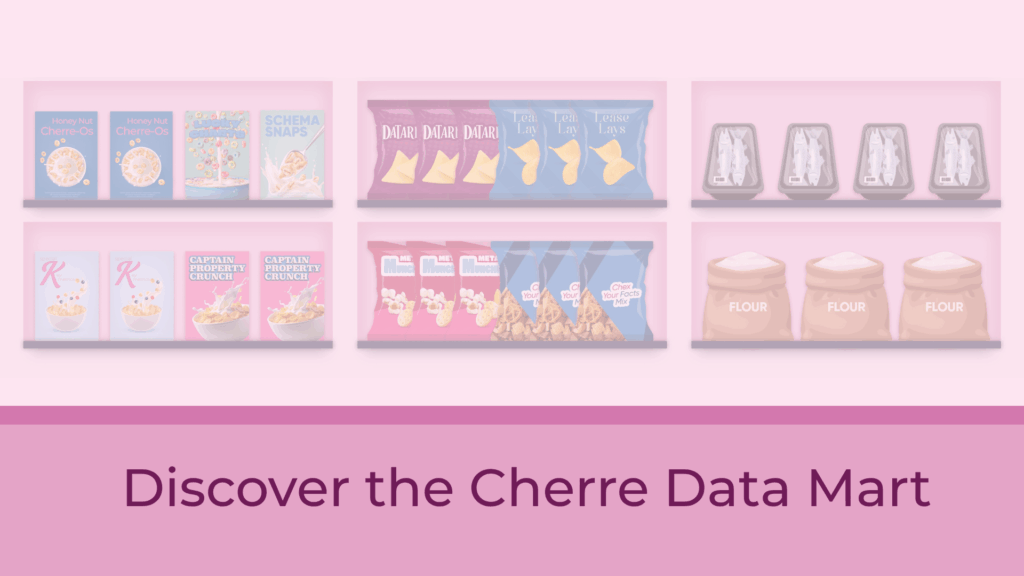
The Cherre Data Mart – a creative installation unveiling this month in Las Vegas at OPTECH – transforms the abstract world of data management into something everyone understands: a grocery store.
You know that feeling when you’re hunting for pasta sauce, but somehow end up in three different aisles because one store calls it “Italian,” another files it under “Sauces & Condiments,” and a third just… puts it with the canned vegetables?
That’s your data right now.
Welcome to the fundamental problem plaguing real estate: ontology chaos. It’s the reason a “unit” in one system is a “property” in another and a “space” in a third. It’s why your NOI calculations don’t match between platforms. It’s why pulling a simple portfolio report feels like assembling IKEA furniture without instructions.
And it’s exactly why we built the Cherre Data Mart experience.
Here’s the thing about data management: everyone talks about “connecting” systems and “integrating” data. But connection without context is just… noise with a fancy API.
Real estate data doesn’t arrive in neat, labeled packages. It shows up:
Without proper ontology – the semantic framework that gives data meaning and relationships – you’re not managing information. You’re managing chaos in different databases.
Let’s get specific. Consider a simple question: “What’s the occupancy rate across my East Coast portfolio?”
Without ontology:
With proper ontology:
This isn’t hypothetical. This is Tuesday for most real estate operators.
Real estate isn’t alone in facing data challenges – healthcare wrestles with patient record systems, finance battles regulatory reporting across jurisdictions, manufacturing coordinates global supply chains. But real estate operates at a uniquely difficult intersection: highly fragmented systems, extreme customization, legacy technology, and asset complexity that spans physical properties, legal entities, financial structures, and operational data.
Your typical portfolio involves:
Trying to connect this with conventional integration tools is like trying to organize a grocery store where every supplier speaks a different language and uses different units of measurement. Sure, you can physically put things on shelves, but good luck helping anyone find what they need. More critically: how do you compare products? How do you assess quality? How do you make informed decisions about what you’re choosing to feed and nourish your portfolio – your business – when you can’t trust that “organic” means the same thing across vendors, or that “low sodium” is measured consistently?
You end up making decisions based on incomplete information, inconsistent definitions, and a prayer that your reconciliation spreadsheet didn’t have a typo.
This is where most data platforms wave their hands and say “AI” or “machine learning” and hope you stop asking questions.
We’re going to tell you exactly how it works:
Cherre CONNECT ingests from 120+ data vendors and countless proprietary systems. But ingestion is table stakes. What matters is what happens next.
Cherre CORE – our universal data and semantic models – doesn’t just dump your data into a lake and call it connected. It maps every piece of information to a unified ontology that understands real estate.
Not “understands data.”
Understands real estate data.
Our knowledge graph connects:
When you connect your systems to Cherre, different parts of the graph illuminate – revealing relationships you didn’t know existed. That Class B multifamily property? It shares ownership structure with three other assets you didn’t realize were related. That address discrepancy? Automatically resolved through our entity resolution engine.
Cherre QUALITY ensures every transformation is auditable. You can trace any data point from insight back to source, with every business rule and validation documented. Because “trust us” isn’t an acceptable answer when you’re managing $3.3 trillion in AUM for the largest asset managers and banks in the industry.
Cherre ALPHA is where trusted, connected data becomes operational – feeding downstream applications, BI tools, AI workflows, and business processes with information you can actually rely on.
Other platforms tell you they “connect” your data. Cherre tells you what it means.
Bad ontology isn’t just annoying. It’s expensive:
Meanwhile, your competitors using Cherre are operating with a single source of truth, making decisions faster, and actually using the incredible wealth of data they’re sitting on.
This November in Las Vegas, Cherre is bringing data chaos to life with The Cherre Data Mart – an immersive, tongue-in-cheek grocery store where ontology goes off the rails.

Grab a shopping list from the Cherre team and hunt down ingredients for our Curious Cupcakes recipe. Sounds easy enough – until you realize this store’s logic is… a little off. As you search for flour, you’ll experience what happens when data is mislabeled, misplaced, or just plain missing. It’s a taste of what real estate data management feels like without proper ontology – confusion, duplication, and plenty of “where on earth is that?” moments.
Find all your ingredients, survive the chaos, and unlock the final StayCurious card at checkout.
Whether you conquer Aisle F or get distracted by a bag of SQL & Vinegar Chips, one thing’s certain – you’ll never see data (or grocery shopping) the same way again.
Stop by The Cherre Data Mart at OPTECH, Booth #472, fill your cart with curiosity, and see how Cherre helps real estate finally make sense of its shelves. Email Keren, at [email protected], if you’d like to chat with the Cherre Team.

We’re incredibly excited to announce that Cherre has joined RealPage.
Together, we’ll continue the same journey we started almost a decade ago at Cherre,

Combination connects property-level operations with institutional portfolio intelligence, giving owners and operators a governed, trusted foundation for better decisions and stronger performance
RICHARDSON,

Commercial real estate is entering territory where the old playbooks stop working. New markets. New asset classes. New operating pressures.