By Ronnie Cook, Senior Vice President of Product Design and Strategy.
Everyone, I mean everyone, is talking about AI and it’s impact to certain industries, and Real Estate is no exception. At CREtech New York this month, 73% of sessions focused on AI. 73%!!
While data scientists and engineers effectively describe AI’s technical capabilities, the message often gets lost on the very people who want it most: the end users who will interact with it daily. Speculative documentaries and futuristic movies are often popular because people want to see what it will be like in the future, or more importantly, what it will feel like.
The problem with these futuristic glimpses is that they’re often either too far out to be relevant, or they miss the mark entirely (we’re still waiting on those flying cars, George Jetson!).
As someone who bridges the gap between engineers and the business – and isn’t afraid to make a near-term prediction – here is an example of what a routine exchange between an AI Agent and an Asset Manager could look like in the very near future.
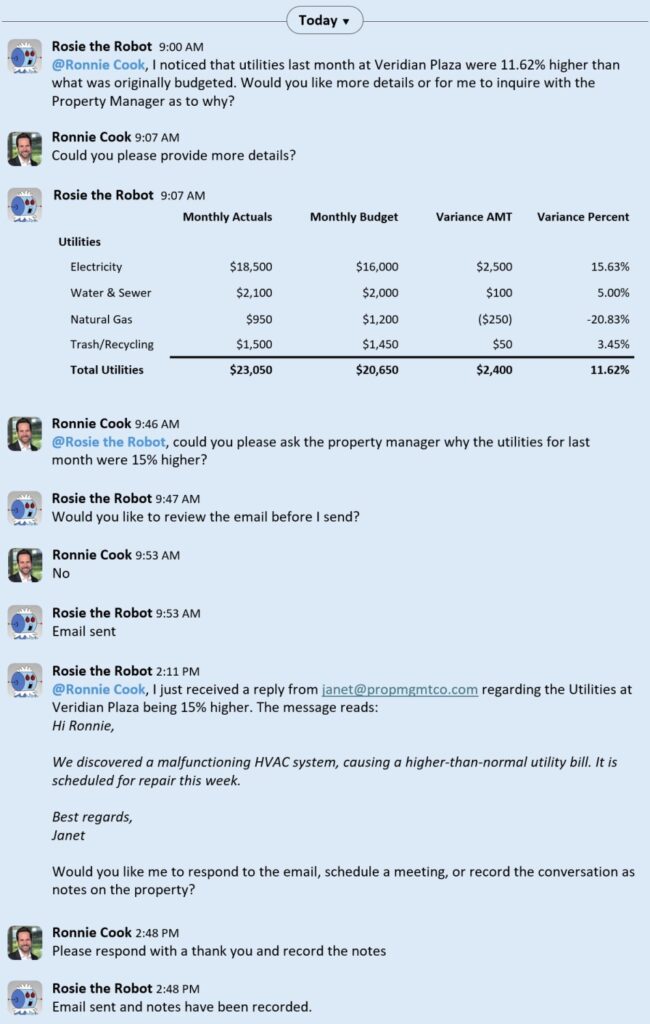
So how realistic is this exchange based on current technologies? Let’s break it down:
Provided an AI agent has the necessary permissions, it can seamlessly communicate with you through a messaging application of your choice, such as Email, SMS/Text, MS Teams, Slack, Reddit, and many other options.
While the current focus for many engineers is often on building dedicated in-platform AI experiences, the true power of these digital assistants lies in their ability to facilitate cross-platform communication – mirroring the diverse and adaptable way human assistants operate today.
Think of an AI agent like an employee who only works when they’re prompted or given a specific task – they don’t just stare at the screen all day. Instead of constantly monitoring everything (which would cost a fortune in computing power), we use triggers or scheduled events.
For example, if you want the agent to spot a problem like “utilities at Veridian Plaza were 11.62% over budget last month,” it needs to be told when and what to look for. We do this with a pre-programmed job. That job runs on a schedule (maybe every day at 9:00 AM) to quickly scan the data. If it finds an exception – say, a cash flow variance over 10% – that event triggers the AI agent to wake up and send an alert to the Asset Manager.
It’s totally possible for an AI to loop through all your data 24/7, but honestly, the cost of the computer power makes that a non-starter for most companies. The smart, affordable way to do it is to give the agent the data it needs and use a simple, timed report as its “on” switch.
In the first prompt from the Digital Assistant you will notice the following question “Would you like more details or for me to inquire with Property Manager as to why?“. Behind this prompt is a preestablished workflow:
The AI Agent is capable of using a predetermined workflow as a guide and then follows the flows based on the inputs or responses it receives.
When the Asset Manager requests ‘more details,’ the system operates on the assumption that a dedicated API or endpoint is available to retrieve that specific information. For example, if the request is ‘provide more details about utilities from last month,’ the agent must be able to call the necessary data source to fulfill the request.
However, if the user provides a prompt that falls outside the pre-defined workflow or requests data the agent cannot access, the response quality degrades significantly. For instance, if asked, ‘Please tell me how utilities compared to what was underwritten,’ but the underwriting data is not integrated, the agent will rely on its general training knowledge. This often results in an answer that is vague, potentially inaccurate, or even completely fabricated (a form of ‘hallucination’). Therefore, precise agent function requires both a clear workflow and secure access to all necessary business data.
The power of a digital assistant is defined by the permissions it holds. While an agent can certainly monitor email and respond on your behalf today, the critical question is not can it, but should it? Its operational capacity is directly tied to the access granted to the agent itself.
If the agent has permissions to send emails, it may do so in a manner or at a time you did not anticipate. This risk extends to API endpoints: defining access is critical. Are you granting it read-only access, or the ability to update, insert, or delete data? The absence of robust controls means there is no guarantee that its automated actions align with your intended outcome.
While low-risk functions, such as capturing notes, are relatively safe, you will need to contemplate before allowing an agent to update a system of record without stringent controls. We should treat the digital assistant similarly to a junior associate: we grant limited, supervised access to critical systems until trust and validation measures are firmly established.
Stop waiting for The Jetsons. Based on where things are right now, we can absolutely make all these amazing AI interactions happen in the very near future. We’re not talking about some far-off dream; we’re talking about putting real, practical AI Agents into the hands of Asset Managers basically today. So get going on identifying the scenarios, making data available, and considering what access or limits you want in place for agents. The future for digital assistants is closer than you think!
If you enjoyed this article, please have your digital assistant follow Ronnie on LinkedIn. 🤖🙂
Ronnie Cook is the Senior Vice President of Product Design and Strategy at Cherre, where he leads the company’s product vision and roadmap. As a former executive in Real Estate Engineering at Goldman Sachs and former Head of Product and Services at Pereview, Ronnie brings a proven track record of delivering purpose-built solutions that solve real client challenges and turn complex data into intelligent, actionable insight.

91% of mid-market companies have adopted generative AI, yet 92% encountered challenges during rollout. A small group of teams are quietly solving the foundation problem to pull ahead.
Multifamily has entered a defining moment. AI is no longer an experiment – it is becoming operational. During NMHC’s OPTECH 2025, leaders didn’t discuss hypothetical use cases; they showcased live deployments, automation wins, and the next wave of agentic innovation taking shape across leasing, operations, compliance, and portfolio performance.
But the most important insight was also the simplest: Multifamily AI will only scale on a strong data foundation.

Whether through direct integration, managed software instances, or intelligent extraction tools, adopting a modern data strategy is the only way to move from managing by hindsight to leading by foresight.